Certain places have a story that deserves its own fragrance.
It may begin with the landscape surrounding a country house, the history of a family-owned hotel or an architect’s particular vision for a new building. Sometimes the reference is less apparent: a material chosen for its personal significance, a familiar ritual or a memory that has remained with someone for years.
Details like these are rarely found in an existing composition. They are where a fragrance made for one place and its people begins.
A Fragrance That Begins with the Place
Every bespoke project begins with an understanding of what makes the place particular.
Architecture offers one perspective. The proportions of a room, the materials used throughout a building and the relationship between its interior and surroundings can reveal much about its character. But the identity of a place is also shaped by less visible things: its history, the intentions of those who created it and the habits of the people who spend time there.
A hotel may have grown from a family home. A private club may have developed its own traditions over decades. A newly conceived property may draw its identity from a landscape or a particular approach to hospitality.
These references help establish the world to which the fragrance will belong.
The fragrance should feel at home in that world from the start, instead of being added to a visual identity that is already finished.
The Human Experience
A building’s identity is also found in the way people experience it.
Consider the difference between arriving at a grand hotel and returning to a familiar private residence. One may be associated with anticipation and a sense of occasion; the other with comfort and recognition. Neither experience can be defined by architecture alone.
Through the Emotional Brief, we explore what the client hopes people will feel in the space, and which associations might help express that intention.
Ingredients do not carry fixed emotions. A rose does not always signify romance, and sandalwood does not guarantee calm. Their meaning depends on the composition, the context and the experiences of the person encountering them.
We look for a fragrance character that fits the experience the client has in mind.
Working with Perfumers
OLFO establishes the creative direction and works with perfumers to explore how it might be expressed.
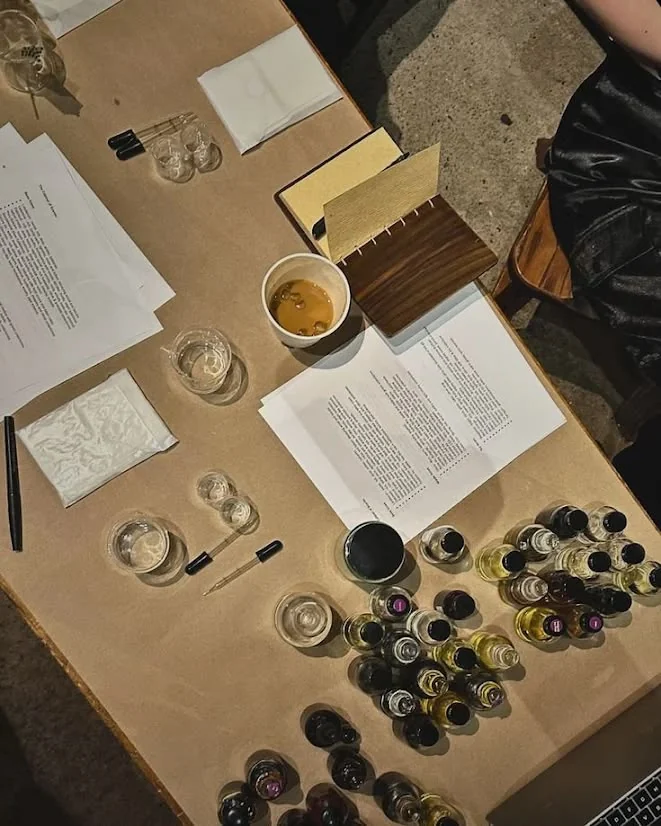
The agreed brief is the starting point for choosing materials and working out the composition and the relationships between individual notes. Different interpretations may be developed and assessed, each revealing something about the possibilities of the original idea.
One interpretation may find the right character straight away, while another may offer an unexpected quality worth exploring. The process involves comparing these possibilities, identifying what feels convincing and determining where further refinement may be needed.
Throughout, we keep the intended setting in mind. Its character on a blotter matters, and so does how it will behave when diffused in an occupied interior.
The result should stand on its own as a fragrance and make sense within the project.
Beyond the Composition
A bespoke fragrance is developed with an eventual setting in mind.
A composition may be delicate when experienced close to the skin or on a blotter, yet require a different assessment when dispersed through a large public room. The scale of the interior, its ventilation and the time people spend within it can all influence how the fragrance is perceived.
That is why fragrance development and diffusion design run side by side.
These factors also show whether a composition suits its intended use, and what needs reviewing before it goes into the building.
An Identity of Its Own
The individuality of a bespoke fragrance does not depend on making it unusual for the sake of being different.
It comes from the particular references that inform it, the choices made during its development and the care taken over where it will be experienced.
A fragrance made this way can become a recognisable part of a place, associated with its character and the experiences that unfold there.
Related